


Coworking Offices
in Warsaw
Coworking stopped being a niche solution for freelancers a long time ago. Today, it is a fully developed workplace concept that is reshaping how companies and professionals think about the traditional office model. More and more businesses are moving away from conventional offices in favour of inspiring environments that support productivity, comfort, and flexibility—places where people can work efficiently alongside others who share similar goals. If you’re wondering what coworking really is and whether it’s the right solution for you, this article answers the most important questions.
What is coworking?
Coworking is a flexible work model in which individuals and companies share a professional office space, paying only for the workspace they actually use. Coworking interiors are typically designed to support comfort and efficiency. It is also common for members to take part in networking events, workshops, and community initiatives, building meaningful business relationships along the way.
Coworking definition – What Is the Idea Behind a Coworking Office?
Coworking is a shared workspace used by business owners, company employees, and freelancers alike. It is a work model based on collaboration, flexibility, and shared resources.
The idea originated in European hacker spaces in the 1990s, where programmers exchanged skills and best practices. Modern coworking, as we know it today, emerged after 2006 and quickly became a global trend.
Within a coworking space, you can use shared open space areas as well as private offices, meeting rooms, and full office facilities—without the need to rent an entire office yourself. Coworking rental agreements are usually far more flexible than traditional office leases.
In practice, this means that instead of signing a long-term lease, you can work how you want, where you want, and for as long as you need. All you need is a membership and access to ready-to-use infrastructure. This is the simplest answer to popular Google searches like “what is coworking” or “coworking definition.”
Coworking was created to offer more than just a desk. It’s about community, knowledge-sharing, flexibility, networking, and access to infrastructure that helps people work smarter and at their own pace.
How does coworking work in practice?
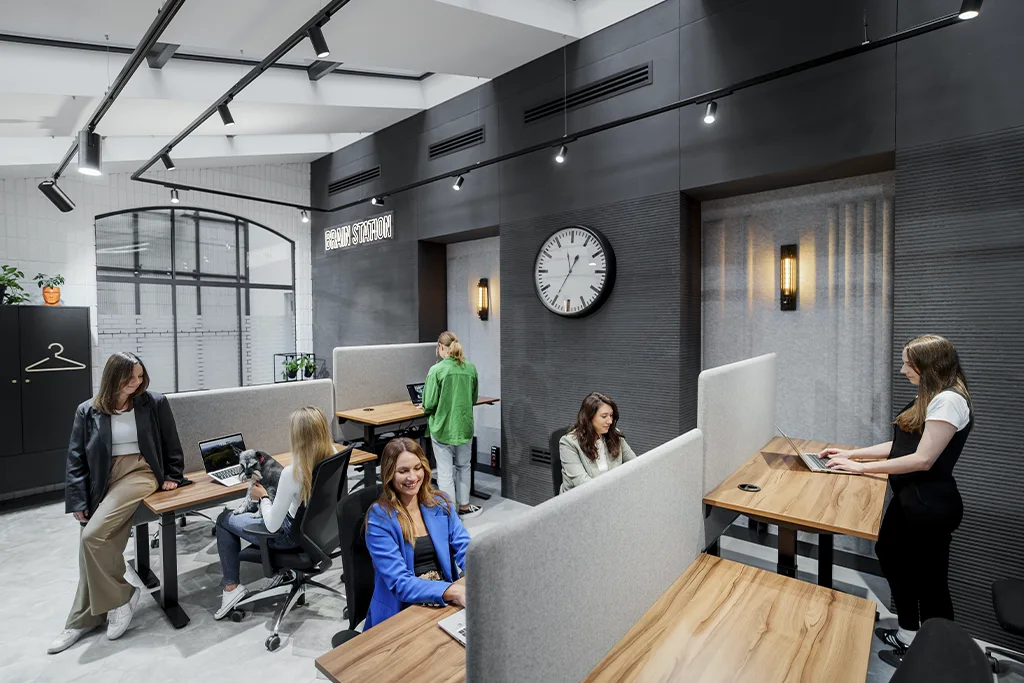
Coworking spaces at Brain Embassy are designed to support both focus and collaboration. You’ll find quiet work zones, phone booths, ergonomic furniture such as height-adjustable desks, high-speed internet, fully equipped kitchens with unlimited coffee, relaxation areas, and modern meeting rooms.
The open space includes a variety of workstations—from large shared tables to individual desks that offer greater privacy.
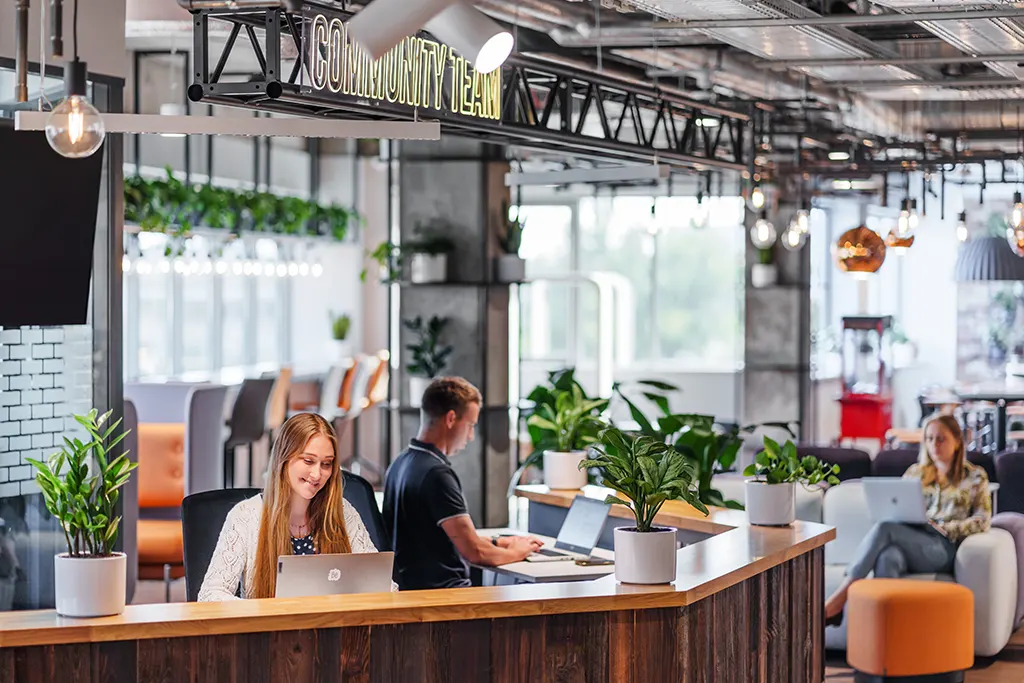
Startups and larger companies can choose private offices or dedicated team spaces known as Company Units, featuring access control. All of this is set within a warm, home-like design, filled with plants and natural daylight.
Coworking is more than just an office. It’s an environment that naturally encourages relationships, meetings, knowledge exchange, and connections that can lead to business collaborations—or simply a coffee together.
At Brain Embassy, networking often happens organically, for example over morning coffee. The community regularly takes part in inspiring expert talks, networking sessions, and themed events, which support both professional development and meaningful connections.
Why is coworking becoming so popular?
Coworking spaces offer 4 key benefits:
- Flexible, client-focused solutions
- Cost savings—you pay only for what you use
- Networking and professional development
- Ready-to-use infrastructure
Flexibility and cost efficiency – an alternative to traditional offices
Renting a traditional office usually involves high costs and long-term commitments. Coworking offers something entirely different: flexibility. You pay only for what you need, when you need it. There’s no need to worry about cleaning, coffee supplies, or equipment maintenance.
This makes coworking an attractive option not only for freelancers, but also for startups and companies looking for office space without major upfront investment. For many businesses, coworking is a smart alternative when flexibility, time efficiency, scalability, and productivity matter most.
Coworking and remote work – focus without isolation
Working from home can be convenient, but for many people it quickly becomes exhausting. Maintaining work–life balance is harder, and isolation doesn’t support creativity. Not everyone also has comfortable conditions to work from home.
Coworking solves this problem. It allows you to keep the freedom of remote work while naturally supporting productivity and well-being. That’s why many remote employees choose coworking spaces as their ideal remote office—maintaining their lifestyle while gaining professional working conditions.
Networking and professional growth – coworking as a space for building business relationships
Coworking is an ecosystem that fuels networking. You meet people facing similar challenges, building businesses, and looking for partners, clients, or investors. This is one of the main reasons many company owners choose coworking over a traditional office.
Meetings, workshops, and everyday conversations often lead to new projects and real business opportunities. At Brain Embassy, new collaborations—and friendships—are formed regularly.
Discover the Rich Event Program at Brain Embassy
Coworking spaces host workshops, educational events, networking sessions, and themed social gatherings. Brain Embassy also offers a unique mentoring programme, Mentors4Brainers, featuring meetings with experienced leaders and mentors who help participants define their professional and personal development paths.
Why is coworking the future of work?
The job market is more dynamic than ever. People increasingly seek freedom, comfort, purpose, and flexibility. Coworking meets these expectations by enabling people to work the way they like and where they choose—surrounded by others who share similar values.
As mobility, hybrid offices, and project-based work become the norm, coworking clearly emerges as the future of work. It balances focused productivity with inspiration, creativity, and continuous growth.
What is the best coworking space in Warsaw?
Coworking in Warsaw – districts and popular locations
Choosing the best coworking space depends on individual needs and expectations. Warsaw currently has around 100 coworking spaces, making it one of the leading coworking markets in Central Europe.
The industry is growing rapidly, which makes location a crucial business decision. For many people, fast commuting, public transport access, parking, ergonomic furniture, and nearby lunch options are key factors.
When choosing a coworking space in Warsaw, it’s also worth paying attention to the surroundings of the building and the attention to detail in workspace design.
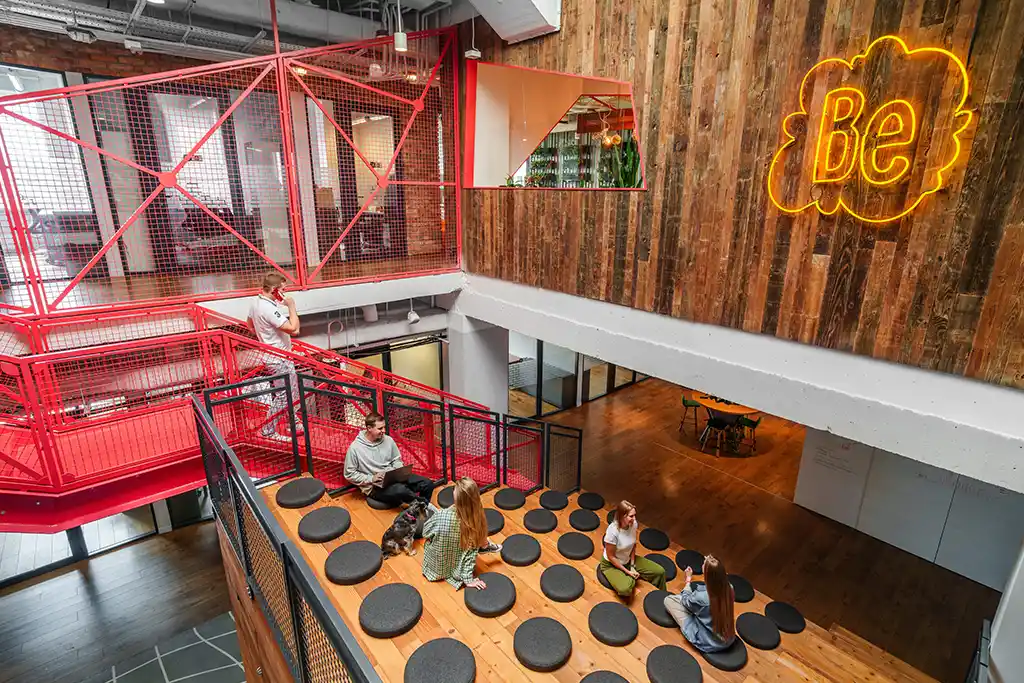
Brain Embassy meets these expectations by offering seven locations across Warsaw. Memberships provide flexible access to all locations depending on your needs.
The best coworking space in Warsaw – what sets it apart?
It is a place that inspires action and supports productivity, creativity, personal growth, and well-being. The best coworking spaces offer agreements tailored to individual needs, flexible private offices that allow you to adjust the number of desks as your team grows, fully equipped meeting rooms, and a friendly, engaged community.
When choosing a coworking space, it’s important to look beyond aesthetics and focus on real opportunities for growth. It also matters whether the space offers professional areas for client meetings and the ability to host events of various sizes. At Brain Embassy, you can book one of many meeting rooms or organise a large-scale event for up to 150 people, creating a true “wow” effect that leaves a strong, positive impression on clients.
It’s also worth checking whether the brand genuinely cares about its community—by offering valuable workshops, events, and networking opportunities. When you visit the space, can you feel that this is a place where you can truly spread your wings?
What amenities do modern coworking offices offer?
Modern coworking offices typically come standard with high-speed internet, ergonomic and comfortable furniture, unlimited coffee, and 24/7 access. More and more often, they also offer additional amenities such as podcast rooms, community events, and relaxation zones for recharging—whether through rest, a quick nap, or meditation—as well as options for active breaks, for example stationary bikes.
For many companies, flexibility is a major advantage. Many coworking spaces also offer the option to purchase a One Day Pass, meaning a single-day rental. This provides freedom and cost control without giving up access to full office facilities.

Coworking vs. traditional office for companies – cost analysis
Coworking or traditional office rental in Warsaw? Differences and advantages each of the options
A traditional office offers full independence, but it requires investment, significant financial outlay, and usually long-term commitments. Renting an office often involves purchasing furniture, signing long-term leases, and independently managing services such as utilities, as well as purchasing and maintaining office equipment.
Coworking works differently. It allows companies to use a ready-made workspace that can be adapted to the needs of the team. This solution is particularly valued by companies experiencing dynamic growth, as it gives them the freedom to introduce changes quickly and flexibly. A traditional office may still be a better option for companies that, for various reasons, prefer not to share space with other organisations.
Brain Embassy also offers so-called Company Units — dedicated spaces designed for larger companies, with the option to rent an entire floor. This is a benefit rarely found on the coworking market.
Why Is Coworking a Great Option for Growing Companies? Comparison of coworking and office for a rent
From a cost perspective, coworking is often more efficient. You don’t pay for unused space or idle equipment. This makes it particularly attractive for companies in growth phases and for testing new markets without long-term commitments.
When is it worth moving from a traditional office to a private coworking office?
It is worth making this move when a traditional office no longer provides the flexibility a company needs. Changes in team size, the desire to adopt a hybrid office model, team reorganisation, or rising rental costs can all act as triggers for change. Private coworking offices make it possible to scale without risk, while also offering companies additional growth opportunities through networking—that is, building new relationships with representatives of other businesses. Renting an office within a coworking space also significantly facilitates talent acquisition and the formation of new business partnerships.
Who is coworking best for?
Freelancers and startups – coworking as a growth tool
Freelancers choose coworking because it provides them with a professional workspace and the opportunity to meet people who may become clients, partners, or mentors. Startups opt for coworking because they prefer not to invest in an office before their business model fully matures. Since coworking agreements do not involve heavy commitments, they can easily adjust their office arrangements to suit their current situation.
Remote and hybrid workers – a space that supports focus
Many people look for a space between home and the corporate office. Coworking offers structure, calm, and separation from home distractions, while maintaining a friendly atmosphere and a sense of community. It’s a great environment for those who want to work remotely, but in a creative, inspiring space and with a sense of community.
Organisations seeking a flexible office model
For companies, coworking is an opportunity to have an office that evolves along with them. One month they may need five desks, and the next—fifteen. In a traditional office, this would be a challenge. In coworking, it is a natural process. Additionally, such a space brings a breath of fresh air thanks to the presence of people from outside the organisation. Networking helps teams find inspiration and gain new knowledge.
How Does Coworking Differ from a Traditional Office? – Comparison Table
| Criterion | Coworking | Traditional Office |
| Contract flexibility | Highly flexible — you pay only for what you use, short-term agreements, the ability to change the number of desks and scale the team. | Long-term commitments, low flexibility, difficult to change the size of the space. |
| Costs | Lower and predictable — no investment in furniture, equipment, or maintenance; no fees for unused space. | Higher costs: purchasing furniture, equipment maintenance, utility bills, cleaning, higher financial risk. |
| Infrastructure | Ready-to-use and fully equipped: high-speed internet, ergonomic furniture, kitchen, unlimited coffee, meeting rooms, phone booths, relaxation areas. | Everything must be arranged independently: internet, furniture, equipment, kitchen, work zones. |
| Networking and community | Organic networking, events, workshops, mentoring (e.g. Mentors4Brainers), community activities, inter-company collaborations. | No natural community — relationships limited to the internal team. |
| Work atmosphere | Creative and supportive of focus and growth; home-like design, plenty of light and plants; diverse work areas. | Depends on the company — often more corporate and less inspiring. |
| Team scalability | High — easy to add or remove desks, move to a larger space (e.g. a Company Unit). | Low — team growth often requires relocation or costly redesign. |
| Options for companies | Desks, open space, private offices, company units, the option to rent an entire floor at Brain Embassy. | Exclusive private space only, without shared areas. |
| Events and development | Access to events, workshops, expert talks, networking sessions, mentoring programmes. | No events — the company must organise them independently. |
| Remote work and comfort | A convenient workspace outside the home that supports focus and reduces isolation. | The office must be designed independently to support concentration and well-being. |
| Entering new markets | Fast and low-risk — the ability to work in a new location without signing multi-year contracts. | High entry costs and the need for long-term leases. |
| Best suited for | Freelancers, startups, companies at various stages of development (including growth phase), hybrid teams, organisations that require flexibility. | Companies that do not want to share space with other organisations. |

How to choose the ideal coworking space?
What should you look for when choosing coworking?
Design alone is not enough. Service quality, an inspiring community, modern meeting rooms, and support for daily productivity matter most. Visiting the space before making a decision is highly recommended.
At Brain Embassy, you can book a tour and explore all the benefits firsthand.
Contact us!
Price, location, business efficiency, community – the four pillars of a good decision
Every company has its own criteria; however, if we were to identify the four most important factors to consider, they would be price, business efficiency, location, and community.
Price should reflect real needs and include all utilities without hidden fees.
Business efficiency largely depends on the workplace itself, which is why it’s worth checking whether the space supports focus and creates a positive atmosphere for the team. Higher employee efficiency directly translates into greater business growth.
Location affects both commute time and the energy with which you start your day. That’s why it matters whether a coworking space is well connected, and whether you and your team have access to parking or bike storage.
Community is, in fact, the most important factor. Coworking is much more than just walls—it is a space shaped by people. It is essential to choose a coworking space that you genuinely enjoy returning to.
Can coworking replace a traditional corporate office?
In many cases, yes. More and more companies are choosing to move away from traditional office leases. Coworking is a model that aligns with the vision of the future of work—one that supports people and allows them to work in a way they enjoy, while becoming more productive at the same time.
Try Brain Embassy for Free!
Not sure if coworking is right for you? We offer a free trial day at each of our locations. Fill in the form and our Community Team will help you experience the atmosphere and possibilities of Brain Embassy.
Summary
Coworking – a flexible solution for the future of work
Coworking changes how we think about offices. It offers spaces that support focus, growth, well-being, and professional relationships. It’s a flexible model that grows with your business and adapts to your team’s needs.
How to find your best coworking space in Warsaw
Choose a space that matches your working style, team needs, and business ambitions. Test a few locations and see where you truly feel at home.
FAQ
Is coworking more cost-effective than renting an office?
Usually yes—you pay only for the space and services you actually use.
Can coworking replace a company office?
In many cases, especially for growing companies.
How much does coworking cost in Warsaw?
Prices vary by location and package but typically range from PLN 1,000 to 1,500 per person per month.
Is coworking suitable for introverts or people who need focus?
Yes—modern coworking spaces offer quiet zones and phone booths designed for concentration.
