


Add meditation to your workday – it's worth it!
Everyday work is increasingly associated with information overload, time pressure, and constant readiness for action. No wonder stress at work and concentration problems have become among the most common challenges employees face today.
This is why meditation is increasingly seen not as a spiritual practice but as a practical tool to support the mind at work. A well-suited practice helps calm tension, regain focus, and better manage energy throughout the day.
In this article:
- You will learn what meditation is and how it affects stress and concentration.
- You will learn simple ways to meditate during your break at work that only take a few minutes.
- You will discover meditation techniques for people who work at a computer.
- You will gain tips on how to create a space conducive to regeneration — at the office and at home.
What is meditation, and why does it support the mind at work?
Definition of meditation – the practice of mindfulness and focus.
Meditation is described as a simple, conscious practice of directing attention – most often to the breath, the body, or the current experience. Contrary to popular belief, it is not about “turning off thoughts,” but about noticing them with greater calm and without judgment.
Meditation understood in this way supports the body’s natural ability to self-regulate. It helps you slow down for a moment, get out of the mode of constant reaction, and gain some distance from the stimuli that accompany everyday work at the computer.
In practice, meditation is your “reset” button. It allows you to step out of the mode of constantly responding to notifications and return to your tasks with a clear head – even if you only have a short moment between meetings.
Meditation can become:
- A short reset for an overloaded mind,
- Training in concentration and mindfulness, supporting memory and focus,
- A gentle way to reduce stress levels throughout the day.
If you’re wondering how to meditate or how to start meditating, the good news is that you don’t need any special skills or long sessions. Even a few minutes of simple practice can make a noticeable difference.
Benefits for people who are stressed and overwhelmed with responsibilities.
Regular meditation helps reduce stress levels, gradually lowering tension and supporting us in maintaining mental balance.
Practiced daily, it can help you:
- Feel calmer and in control,
- Improve your memory and concentration,
- Improve the quality of your sleep and recovery,
- Increase your resistance to stressful situations,
- Regain your balance more quickly after difficult moments at work.
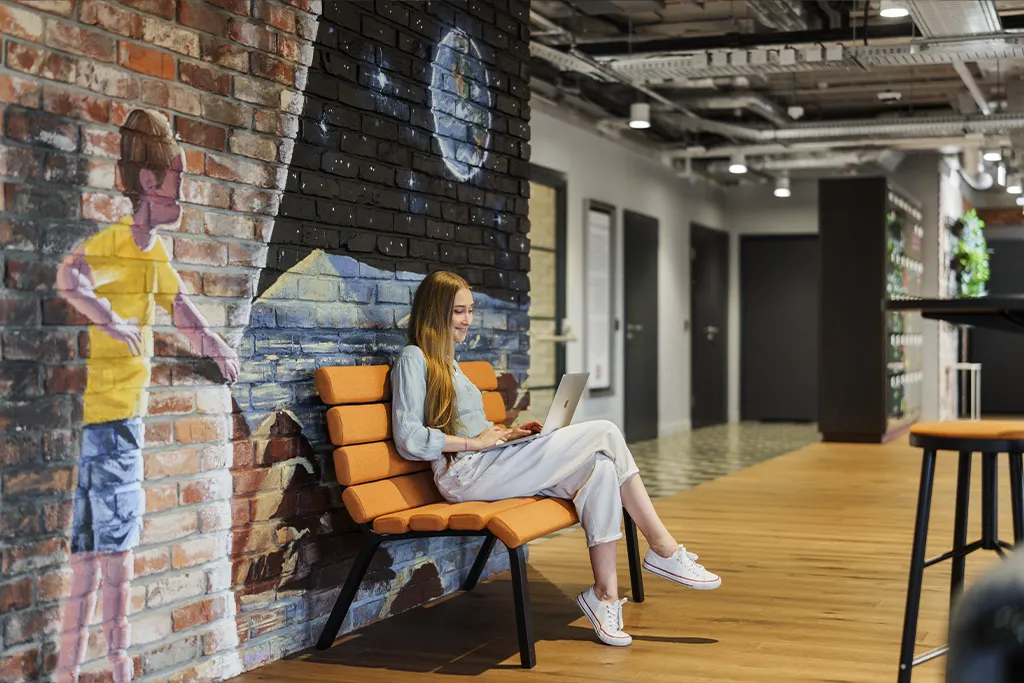
Stress and concentration problems in office and remote work
We know that sometimes the best thing you can do for your project is… to stop and take a breath. Calming your racing thoughts can help you reorganize everything and catch what you forgot along the way or find a better solution. That’s why at Brain Embassy we design meditation rooms – places where you can simply close your eyes and recharge your batteries before the next challenge.
The most common causes of stress in the workplace
Stress in the workplace is your body’s specific response to a situation where demands outweigh resources. A feeling of overload arises. When pressure becomes your constant companion and time for regeneration ends up at the bottom of your list of priorities, your body begins to send warning signals.
In practice, stress at work often arises in situations that sound familiar:
- Deadlines “for yesterday,”
- Online meetings one after another,
- No moment of silence to catch your breath,
- The feeling of being “alone with your problems,” especially when working remotely.
That is why feeling stressed at work is now considered one of the main factors reducing concentration and efficiency.
Why does concentration decline when working on a computer?
Working on a computer for many hours puts a heavy strain on your attention. Your mind is constantly bombarded with stimuli, which can lead to:
- Cognitive fatigue,
- More frequent distractions,
- Difficulty maintaining focus,
- A decline in creativity.

How does meditation reduce stress and improve concentration?
Concentration and mindfulness exercises, short breaks, and mindfulness meditation are increasingly seen as effective ways to cope with stress and overload.
The impact of meditation on the nervous system and emotions.
Meditation not only helps to reduce stress levels, but also to better regulate emotions at work. Emotions often arise suddenly—before a meeting, after a difficult conversation, or when faced with another “urgent” task—and accumulate, affecting concentration.
Regular meditation helps you:
- Notice tension and emotions more quickly,
- Respond more calmly to pressure and deadlines,
- Lower cortisol levels and irritability,
- Return to balance more quickly after stress,
- Get out of constant alert mode.
This makes emotions easier to bear and helps the mind regain clarity and focus more quickly.
Better focus and greater productivity
Meditation acts as mental training:
- It improves memory and concentration,
- It increases the ability to focus on a single task,
- It shortens the time needed to return to work after a break.
As a result, meditation helps you work more effectively. That is why at Brain Embassy, we have created spaces for calm and meditation, so that concentration and regeneration are a natural part of the working day.
Meditation as a form of prevention in situations of burnout
Meditation is increasingly being talked about as a tool for preventing burnout. Regularly pausing and connecting with your body allows you to notice signs of overload earlier. It is also a way to build empathy towards yourself and respond to the first signs of fatigue before they turn into long-term burnout.
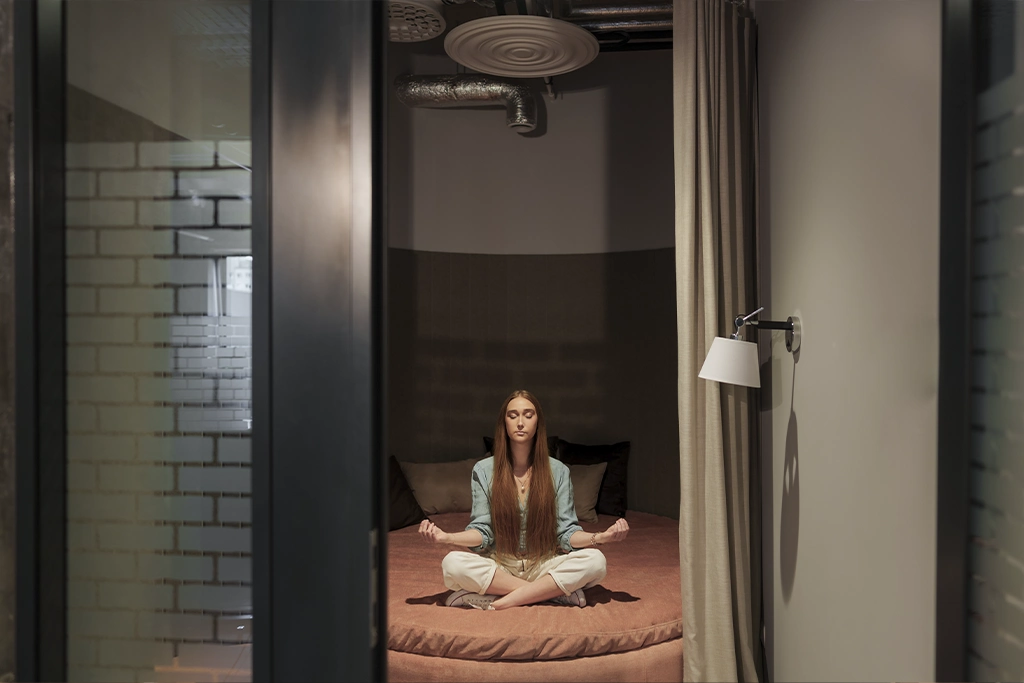
Simple meditation techniques for employees
The simplest form of meditation for beginners is to focus on your breathing:
- Sit comfortably,
- Focus your attention on your breathing,
- Breathe for 3–5 minutes, lengthening and calming your exhalation
- If the practice comes easily to you, you can lengthen your breath, counting, for example, to five on the inhale and to 10 on the exhale—taking your time, slowly calming and lengthening your breath.
- After each inhale and exhale, you can take a 2-second break, holding your breath – this technique has its roots in ancient Eastern teachings (known as pranayama).
Breathing exercises are one of the fastest stress reduction techniques that can be performed here and now, including at work, at home, or even on the bus.
Breathing techniques – Pranayama
4-4-4-4 breathing (box breathing)
- Inhale for 4 seconds,
- Hold your breath for another 4 seconds,
- Exhale for 4 seconds,
- Hold your breath for another 4 seconds.
Repeat 4-5 cycles at a calm pace. This method gives a sense of balance and rhythm.
Breathing with prolonged exhalation (e.g., 4-7-8)
- Inhale for 4 seconds,
- Hold your breath for 7 seconds,
- Exhale for 8 seconds.
This rhythm allows you to activate the parasympathetic nervous system—responsible for rest and regeneration—faster than normal, shallow breathing.
A big advantage of breathing exercises is that you can do them at your desk, between tasks, or on your way to a meeting. In fact, it is an effective form of meditation that has a beneficial effect on your body, no matter where you are.

Body scan – relaxing your body at your desk or on the sofa
A body scan involves consciously “scanning” your body, which allows you to release tension and reconnect with your body.
- Get into a comfortable position,
- Close your eyes,
- Focus your attention on your breathing, then slow it down and deepen it,
- Start scanning your body, starting with your feet and ending at the top of your head – name each part of your body in turn, imagining that you are breathing in air into that very place,
- As you scan, observe whether you feel tension, pain, or anything else in any of these areas.
- Give yourself time and don’t rush the process — if you feel discomfort somewhere, stay with that area longer, breathing even more deeply.
- When you have finished scanning, give yourself a moment to absorb the experience and slowly open your eyes.
This is an ideal exercise for focusing your attention after several hours of work.
Mindfulness meditation at work
Mindfulness meditation does not require you to close your eyes or tune out your surroundings. It can be a brief moment of mindfulness woven into your daily activities that helps you calm your mind and return to work with greater clarity.
Conscious tea or coffee drinking
This is one of the simplest forms of mindfulness that you can practice even in between tasks:
- Pause for a moment and put your phone away,
- Notice the warmth of the cup in your hands,
- Smell the aroma of the drink and taste it with your first sip,
- Observe your breathing and how your body reacts to the moment of pause.
Even 2-3 minutes of such a mindful break can help you break out of automatic mode and reduce tension.

Walk mindfully around the office or coworking space
A short walk can become a form of meditation in motion:
- Walk slower than usual,
- Pay attention to the contact between your feet and the floor,
- Notice the sounds, light, and space around you; you can name the shapes and colors you see,
- Let your thoughts come and go without following them.
Such a moment of mindful movement helps to relieve tension and “clear your head” between meetings.
A brief pause before the next meeting
Before joining the next video meeting:
- Take three calm breaths.
- Feel your body resting on the chair or floor.
- Name your current state in your mind (“I am happy” or “I am tired”).
This is a small gesture that helps you approach the next task with greater mindfulness.

Visualizations and short relaxation sessions
Visualization is a simple technique that involves consciously directing your imagination toward an image associated with calmness, safety, and joy. It can be particularly helpful in moments of emotional overload.
Visualization of a safe, regenerating place
- Sit comfortably and close your eyes.
- Focus your attention on calm breathing—without changing its rhythm.
- Imagine a place where you feel safe and at ease (e.g., a beach, a forest, mountains, a clearing with flowers in the sun and birds singing, a cozy room).
- Notice the details: colors, sounds, temperature, smells.
- Allow yourself to “be” in this place for 1-3 minutes, breathing calmly.
- Finally, slowly bring your attention back to your body and surroundings.
Such short visualizations, especially when combined with relaxing music or meditation music, help calm the nervous system and restore a sense of balance — even in the middle of a busy workday.
Which meditation technique should you choose during the workday?
Not every meditation technique will work in every situation. The following list will help you choose a practice that suits the time of day, your level of fatigue, and your workplace, so that meditation is a real support rather than another chore.
| Meditation technique | How long does it take? | Where does it work best? | Main benefit |
| Focus on breathing | 2–5 minutes | office, open space, home | Quick stress reduction |
| 4-4-4-4 Breathing | 3–5 minutes | Open space, before a meeting | Calming the nervous system |
| 4-7-8 Breathing | 3–4 minutes | Home, a quiet place | Deep calm |
| Body scan | 5–10 minutes | Home, meditation room | Relieving tension in the body |
| Mindfulness in motion | 2–5 minutes | Coworking, break from work | Reset attention and concentration |
| Visualization | 3–7 minutes | Home, a quiet place | Sense of security |

Meditation in office work and remote work – differences and tips
How to practice meditation in an open space?
If you work in a coworking space, look for a space that allows you to calm down and regenerate. At Brain Embassy, there are dedicated meditation and relaxation rooms that will allow you to enjoy a moment of silence even on a busy workday.
The following things can help in an open space:
- Headphones and meditation music,
- Short breathing exercises,
- Mindfulness techniques that do not require isolation.
Even 2-5 minutes of conscious breathing, focusing on your body or listening to appropriate meditative sounds through headphones, can help reduce tension and allow you to return to work with greater calm and concentration.
Creating a space for meditation at home
We can start by designating a simple place in our home that will be associated with peace and focus—it doesn’t have to be perfect, but it’s important that it’s permanent and conducive to calmness.
It may also be helpful to introduce a short ritual, for example:
- Morning meditation before leaving home,
- Meditation after finishing work,
- A few minutes of mindfulness before the first task of the day,
- A short practice after returning from a break or a walk.
Remember that even 5 minutes of regular meditation brings more benefits than long, sporadic practices.
How to start practicing meditation every day?
Short sessions instead of long training sessions
If you’re wondering how to start meditating, the answer is: briefly and regularly. Even 5 minutes a day makes a difference.
Apps and recordings to support regularity
The following may be helpful:
- Meditation apps – e.g., Calm, Headspace, Insight Timer
- Relaxing music for meditation.
Building a meditation habit at work
It is best to treat meditation as:
- An element of occupational hygiene,
- A natural break,
- An investment in mental health,
- An improvement in perceived job satisfaction,
- An increase in work efficiency,
- A greater willingness to engage in work.
Frequently asked questions about meditation at work
Is a few minutes of meditation at your desk enough?
Studies show that just 3–5 minutes of conscious breathing lowers cortisol levels, the hormone responsible for stress. You don’t have to go on a week-long retreat to feel the difference in how you cope with the intensity of the day.
How long should meditation last?
Just as long as it takes to brew a good cup of coffee. Even 3-5 minutes will be enough to “unplug” your mind from stress and regain clarity of thought. Remember that meditation is about regularity. It’s like brushing your teeth – it’s better to do it briefly every day than once a week for an hour.
Can you meditate in an open space?
Yes! Breathing techniques and mindfulness can be practiced almost imperceptibly, while looking at your monitor or walking to the kitchen to get a drink of water. And if you need complete isolation, our spaces offer dedicated meditation rooms and quiet work areas where silence is the norm.
Summary
Meditation as a simple way to reduce stress and improve concentration at work
Meditation is one of the simplest and most accessible tools for coping with stress and improving concentration – whether in the office, a coworking space, or when working remotely.
Call to action – try 5 minutes of meditation today
Stop. Take a breath.
Find 5 minutes – and see how little it takes to feel the difference.
Good luck!
